
Our client Jim ( name changed) was knocked off his bike in The City by a black cab in January 2014.
Liability was admitted. Jim suffered a serious injury to his right shoulder and was not able to work as a courier for about 10 weeks. He had only a small amount of savings to live on.
Before Jim had had time to speak to us, the cabbie's insurers- Haven Insurance- offered £2000 to settle his claim. This is how they put it to him:-
"We offer you the opportunity to settle your claim with us directly in the sum of £2000. Traditionally, this is done by seeking the services of a solicitor; however we offer a service that is very much similar to that offered by a solicitor. What we offer to you directly is the option to conclude your injury claim without the need for further inconvenience".
Given that Haven represent no one but the interests of their shareholders and policyholders, it is disgraceful that they suggest to accident victims that they provide a service similar in any way to an independent solicitor, who will only be concerned to represent the interests of his client.
After we were instructed to act for Jim the insurer's next gambit was to make an offer of £6750.00 before we had any medical evidence about the extent of the injuries and any disability. This caused Jim anxiety because if he rejected the offer and failed to beat it at a later trial he would be penalised in costs. Fortunately we were able to arrange a medical report quickly and on that basis valued the claim at over £15,000.00.
After hard negotiation Jim decided to accept an offer of over £12,750: six times the original offer from Haven.
Insurance companies work on the basis that a good percentage of accident victims will accept the first offer made and before they have sought legal advice. Don't be tempted; you are likely to be accepting a grossly inadequate settlement which you will come to regret.
Consult an experienced solicitor. Don't let insurers treat you like a fool!

23 April 2014
Cyclist Hits Pothole Outside Battleship Building, Harrow
On 6 November 2012 David (name changed) an
experienced cycle courier was halfway through his workday of deliveries around London,
and looking for the safest route to the Battleship Building on the Harrow Road.
After reviewing the case, we determined
that Westminster Council was responsible for the highway directly under the
A404 overpass. Council highway authorities are under a statutory duty to
maintain public highways to a safe and reasonable standard. Had the highway
authority maintained this road, David would have been in good health and not
out of work for many months.
The
defence
As with many pothole cases, Westminster
Council rested its defence on the grounds that they inspected roads in the
borough on a regular basis ( monthly in this case). The Council provided
detailed inspection records. But they made a critical error. They claimed that
anything over 55 millimeters deep would be deemed a defective pothole thus
requiring repairs.
We were able to research this topic and
provided evidence that under the borough’s Highways Maintenance Management Plan
published in 2005, a defective pothole must be deeper than 22 millimeters to
require fixing. Based on David’s photographs provided from the scene of the
accident, the two potholes in question were clearly deeper than 22 millimetres.
Further, we were able to demonstrate that
the council inspectors failed to identify the potholes on two visits in late
November and December, in other words
after the accident, and the implication was therefore that they had also missed
the potholes in October 2012, before the accident. So, while the policy was in
line with a decent statutory defence the implementation was not, proving fatal
to any defence, in our view.
The council at no time admitted fault and
court proceedings were commenced on 5 November 2013, on behalf of David, and
after we had endeavored to settle the claim in October.
In January 2014 the defendant made an
acceptable offer in line with our valuation. Our client recovered £6,800 damages.
Pothole cases are often aggressively defended
by local authorities and a high proportion require the claimant to issue court
proceedings before any settlement is possible. In such circumstances you need
experienced and expert legal advice on the merits of your case to be confident
about pursuing a claim successfully.
We firmly contend that holding highway authorities accountable for potholes
over time contributes to the safety of all road users in improved practice
and maintenance.
Joshua O’Connor, Dowse & Co.- April
2014
26 March 2014
Potholes in the UK and Cyclists: some advice
Every cyclist hits a pothole on the road sometime.
If cycling on the public highway in the UK, all local authorities have a statutory responsibility to maintain and repair the road such that it is reasonably safe for expected traffic.
If you are injured or your bike is damaged, the starting point is to determine if the pothole is a foreseeable danger to cyclists. There are no rules about what size pothole qualifies but a court will have to be convinced that it was dangerous enough to cause an accident in the particular circumstances and with regard to the road user: for example, gaps around a drain cover can be a real danger to cyclists but not to a motorist.
| Potholes are a menace for bikes |
Local authorities can defeat pothole claims by demonstrating that they have a robust inspection, repair and maintenance programme in place. So, although a pothole may have caused an accident if the council had acted reasonably to maintain the road, despite the accident, the claim will fail.
Compensation can be reduced for contributory fault if the court finds that a cyclists wasn’t paying enough attention to the road ahead ( and ironically, the larger the hole the more likely that a council can run a successful argument), or if the pothole was on a familiar route, or near the cyclist’s home. All road users are expected to take reasonable care of their own safety, and that includes keeping a look out on the road ahead.
Make sure you take photos of the pothole and note its precise location. If there were witnesses take their details. Don't delay in seeking medical attention and tell your doctor about the accident.
At Dowse & Co we have a track record of vigorously pursuing pothole claims and have won many cases contested hard by local authorities.
Call Patrick Spence with any queries on 0207 254 6205.
19 February 2014
CYCLISTS INJURED IN HIT AND RUN ARE ENTITLED TO COMPENSATION
What legal remedy does a cyclist have where they are the victim of a hit and run accident?
Such incidents are all too common in London. Recent figures from the Metropolitan Police suggest that about 15 cyclists a week are killed or injured as a result of a hit and run. Cyclists account for about 20% of casualties arising from hit and runs, even though they account for only about 2% of journeys made on our roads.
Untraced Driver’s Agreement
If you are the victim of a hit and run, and suffer injury, you can make an application for compensation under the Untraced Drivers Agreement (“UDA”) to the Motor Insurers Bureau (“MIB”). Obviously, you can only make a claim where the driver responsible cannot be identified.
To succeed in such a claim, it is essential that the incident is reported to the police and that you have a crime reference number, or some other form of acknowledgment from the police.
Under the Agreement you must report the incident within 14 days of its occurrence (or not later than 5 days where you are also claiming property damages). The time limits can only be extended where it was not reasonably possible to meet them.
If you are in doubt about whether you may want to make a claim you should at least protect your position by reporting to the police which will enable them to undertake any investigation that might lead to the driver being traced and if need be prosecuted.
The MIB, if they accept the claim, will commission a medical report before making an offer of compensation. There is an appeal process if the offer made is unacceptable.
The MIB will make a contribution to the cyclist’s legal costs where they have had professional advice in making the application, reviewing the correctness of the decision, and advice about the adequacy of the award, including drafting an appeal if necessary. So its worth seeking legal advice before you try to claim yourself, unless you are confident you can master the claim procedure
Call Patrick Spence on 020 7254 6205 or e-mail ps@dowse.co.uk if you have any further queries about hit and run claims, or if you need assistance in pursuing such an application.
Such incidents are all too common in London. Recent figures from the Metropolitan Police suggest that about 15 cyclists a week are killed or injured as a result of a hit and run. Cyclists account for about 20% of casualties arising from hit and runs, even though they account for only about 2% of journeys made on our roads.
Untraced Driver’s Agreement
If you are the victim of a hit and run, and suffer injury, you can make an application for compensation under the Untraced Drivers Agreement (“UDA”) to the Motor Insurers Bureau (“MIB”). Obviously, you can only make a claim where the driver responsible cannot be identified.
To succeed in such a claim, it is essential that the incident is reported to the police and that you have a crime reference number, or some other form of acknowledgment from the police.
Under the Agreement you must report the incident within 14 days of its occurrence (or not later than 5 days where you are also claiming property damages). The time limits can only be extended where it was not reasonably possible to meet them.
If you are in doubt about whether you may want to make a claim you should at least protect your position by reporting to the police which will enable them to undertake any investigation that might lead to the driver being traced and if need be prosecuted.
The MIB, if they accept the claim, will commission a medical report before making an offer of compensation. There is an appeal process if the offer made is unacceptable.
The MIB will make a contribution to the cyclist’s legal costs where they have had professional advice in making the application, reviewing the correctness of the decision, and advice about the adequacy of the award, including drafting an appeal if necessary. So its worth seeking legal advice before you try to claim yourself, unless you are confident you can master the claim procedure
Call Patrick Spence on 020 7254 6205 or e-mail ps@dowse.co.uk if you have any further queries about hit and run claims, or if you need assistance in pursuing such an application.
23 January 2014
Cost budget variations: this is not going to end well.
Our senior litigator Myles Hickey has published this letter in the Law Gazette highlighting the negative affects new budget rules will have on the management of claims if courts go by the book:-
DJ Lethem's informed commentary (Variation of budgets - part
1 LSG 18.11.2013) reveals the problem caused by CPR PD3E paragraph 2.4. The
court may only approve prospective budget variations. So if the litigator has
responded to developments in the case to keep it moving before getting those
steps approved, he or she would have to hope for a pragmatic and liberal
interpretation of CPR 3.18 on detailed assessment at the end of the case (no
departure from an approved or agreed budget "unless satisfied that there
is good reason to do so"). As Christopher Lethem notes, such a calculated
breach of the budget is a strategy fraught with danger. As a member of the
CPRC, he should know.
He develops this in part 2 of his article (LSG 25.11.2013)
with the observation that in the post Jackson costs regime, where
proportionality trumps reasonableness, it is likely that standard basis
assessment will reduce recoverable costs, so only the brave will seek detailed
assessment.
Therefore litigators have no
realistic alternative to seeking prospective budget variations once the budget
is in danger of being exceeded. And they are then faced with the task of
showing the variation is warranted through significant developments in the
case, rather than oversight (or perhaps optimism that the opponent would
cooperate) and all against the elegant and unpredictable yardstick of
“proportionality”. This PD seems to me a recipe for slowing down litigation,
snarling up court lists with applications and denying effective access to
justice for those with cases with low or moderate multi-track value.
There is raucous approval in
some commentary on the Jackson reforms by judges (though not this one) and
defendant costs lawyers at the new powers of the courts to strip out costs.
There is much talk of "robust" approaches. What it means in fact is
that paying parties are likely to get a windfall, thoroughly undeserved,
through the new provisions if they are not applied intelligently. As others
have noted, this is an unfair and regressive outcome of changes which surely
could not have been intended. The way to ensure justice on costs budgeting is
for courts to adopt a low threshold for approving proposed budget variations
and tackle paying parties’ objections “robustly”. Otherwise the “costs
wars” of the past 20 or so years will seem like playground games by
comparison.
Myles Hickey
7 January 2014
Car Passengers and the duty to cyclists
Paragraph 239 of the
Highway Code imposes a duty upon drivers before they or their passenger(s) open
a door, to make sure that it will not hit anyone passing on the road or
pavement, or force them to swerve. They have a duty particularly to watch out
for pedestrians, cyclists and motor cyclists.
Greta, a young, fit
and experienced cyclist was knocked off her bike at night by an offside
passenger who did not check before opening the door into her path. Greta’s bike
was properly lit. Greta struck the car door
side on, and suffered spiral fractures to the metacarpals of two fingers on her
left hand, which was trapped between her handlebar and the door. She also had some small scarring to her face
where she struck the floor.
The Police were
uninterested in pursuing the passenger for a breach of her duties to Greta. However,
failure by the Police to act is not by any means fatal to pursuing a
successful civil claim. A person will
not be convicted unless they are believed to be guilty beyond reasonable doubt.
Civil claims are proved “on the
balance of probabilities” which means “more likely than not”. A claim was therefore made against the
driver, who was insured. Insurers will normally deal with the
liability of their insured’s passengers in these circumstances.
Although the
passenger had been pretty unhelpful to Greta and had assumed that Police
disinterest meant that she would face no further claims, her insurers took a
more realistic attitude. They did not
allege that Greta had been cycling too close to the vehicle. They did raise the absence of a cycling
helmet as contributing to the facial injury Greta had suffered.
There were claims for
loss of income (Greta had a number of casual jobs, paid in cash and proving
loss was difficult). They initially
proposed a settlement figure of £10,000 but we persuaded them that a more
realistic settlement would be £12,500. We made allowance for a possible
argument about the absence of a cycle helmet contributing to the minor scar on
her forehead. (The law on cycle helmets
is that the defendant has to show that the wearing of a helmet would have
avoided or significantly reduced the chance of injury; it is likely if they succeed in proving
that, the injured claimant’s
compensation for that injury will be
reduced by about 15%).
The insurers also
paid Greta’s costs, although under the
new costs regime which the Government introduced last April, Greta had to make a contribution. The Government has fixed costs recoverable
from the driver’s insurer at an unrealistically low rate, which means that accident victims will
commonly have to contribute to the cost of getting compensation. Part of that cost is to pay the insurance
premium for the policy taken out on all “No Win – No Fee” cases to protect the
claimant against costs orders they may face.
9 December 2013
Slipping on Snow and Ice: and the duty of your local council
Since 2003 your local authority has been under a statutory duty to ensure "so far as is reasonably practicable, safe passage along a highway is not endangered by snow and ice". The highway includes the roadway and pavement.
What does that mean?
It is the responsibility of our courts to define what Parliament means when it introduces a new law. However, and so far, in the last 10 years there have been no reported cases where a senior judge has had to determine the circumstance when a local authority might breach its statutory duty to clear snow and ice. (That may change if the UK continues to suffer cold winters as recently has been the case.)
This is no surprise. Councils are bound to be given significant latitude in such cases where the public interest in committing limited (tax payers) resources to clear snow and ice must be balanced against our private rights to be reasonably safe when using the highway. So long as a local council appears to have acted reasonably and have adopted and executed a half sensible policy to prioritise snow clearance, few judges will be willing to override that, accept in the most egregious cases.
On the other hand, where injuries suffered are serious and life changing, the courts will expect a local authority to account for their actions if there is any evidence that snow and ice was responsible and ought reasonably to have been cleared before any accident.
In our borough of Hackney while the main roads are cleared and salted quickly after snow that often is not the case with side streets and residential areas. For pedestrians, pavements can become ice rinks outside their homes and where they have little choice but to negotiate, if they are to get to work or to local shops.
After a heavy snow fall how long should a council be allowed before clearing your street? Perhaps 7 to 14 days is reasonable for a side road but more than that might require a proper explanation, in our view.
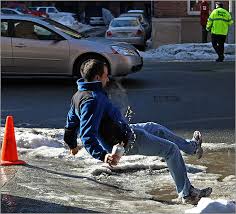
Evidence will be crucial- eg. independent witnesses, photographs of the road or pavement, statements from neighbours about the delay in clearance- and if there have been recorded complaints about the same stretch of road that have not been acted on that will help to establish a breach of duty
We are happy to review a claim if you are unlucky enough to suffer injury by a fall on snow or ice.
What does that mean?
It is the responsibility of our courts to define what Parliament means when it introduces a new law. However, and so far, in the last 10 years there have been no reported cases where a senior judge has had to determine the circumstance when a local authority might breach its statutory duty to clear snow and ice. (That may change if the UK continues to suffer cold winters as recently has been the case.)
This is no surprise. Councils are bound to be given significant latitude in such cases where the public interest in committing limited (tax payers) resources to clear snow and ice must be balanced against our private rights to be reasonably safe when using the highway. So long as a local council appears to have acted reasonably and have adopted and executed a half sensible policy to prioritise snow clearance, few judges will be willing to override that, accept in the most egregious cases.
On the other hand, where injuries suffered are serious and life changing, the courts will expect a local authority to account for their actions if there is any evidence that snow and ice was responsible and ought reasonably to have been cleared before any accident.
In our borough of Hackney while the main roads are cleared and salted quickly after snow that often is not the case with side streets and residential areas. For pedestrians, pavements can become ice rinks outside their homes and where they have little choice but to negotiate, if they are to get to work or to local shops.
After a heavy snow fall how long should a council be allowed before clearing your street? Perhaps 7 to 14 days is reasonable for a side road but more than that might require a proper explanation, in our view.
Evidence will be crucial- eg. independent witnesses, photographs of the road or pavement, statements from neighbours about the delay in clearance- and if there have been recorded complaints about the same stretch of road that have not been acted on that will help to establish a breach of duty
We are happy to review a claim if you are unlucky enough to suffer injury by a fall on snow or ice.
Subscribe to:
Posts (Atom)

